
Browse From Your Own Residential IP Anywhere in the World.
Stop getting blocked by banking CAPTCHAs, work portals, and streaming checks on shared commercial VPNs. Turn any blank $4/mo cloud server into your own Cloud VPN Router, disguised as normal HTTPS traffic on strict hotel or airport Wi-Fi, and route cleanly through any upstream WireGuard tunnel (such as a home router, dedicated residential IP, or commercial VPN) with zero terminal commands.
Software-only license: Requires your own ~$4/mo Linux VPS & upstream WireGuard endpoint (sold separately).
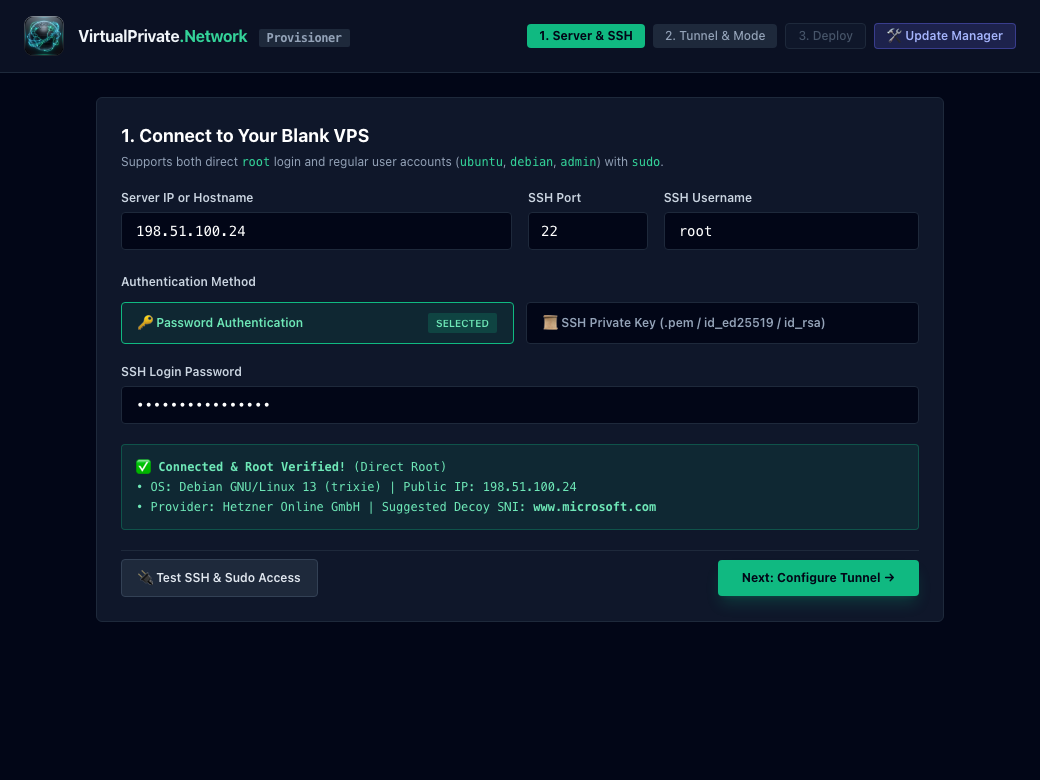
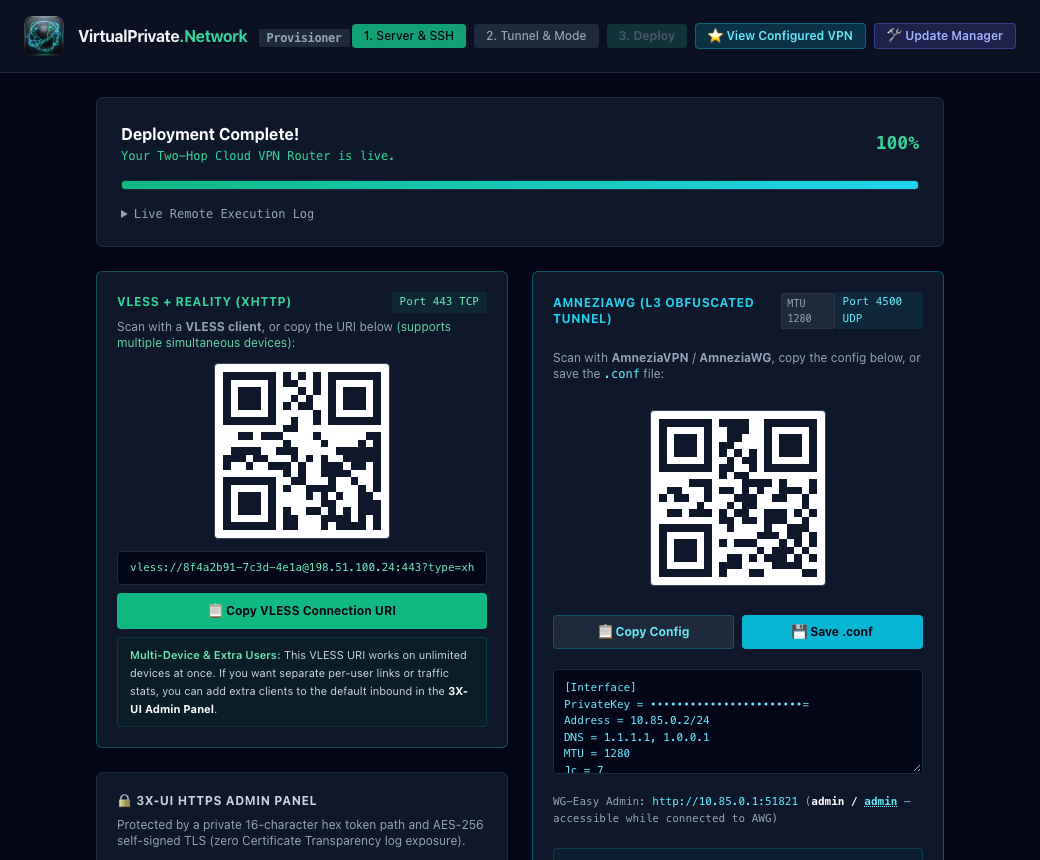
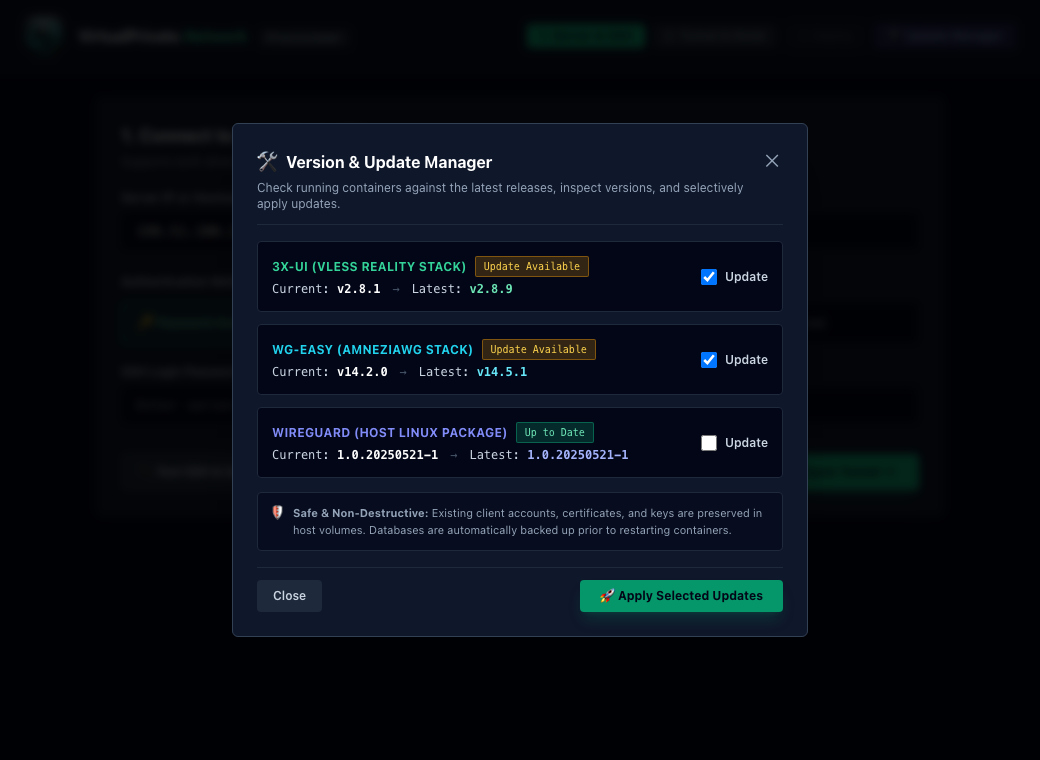
Interface previews are for illustrative purposes only and are subject to change in the actual application.
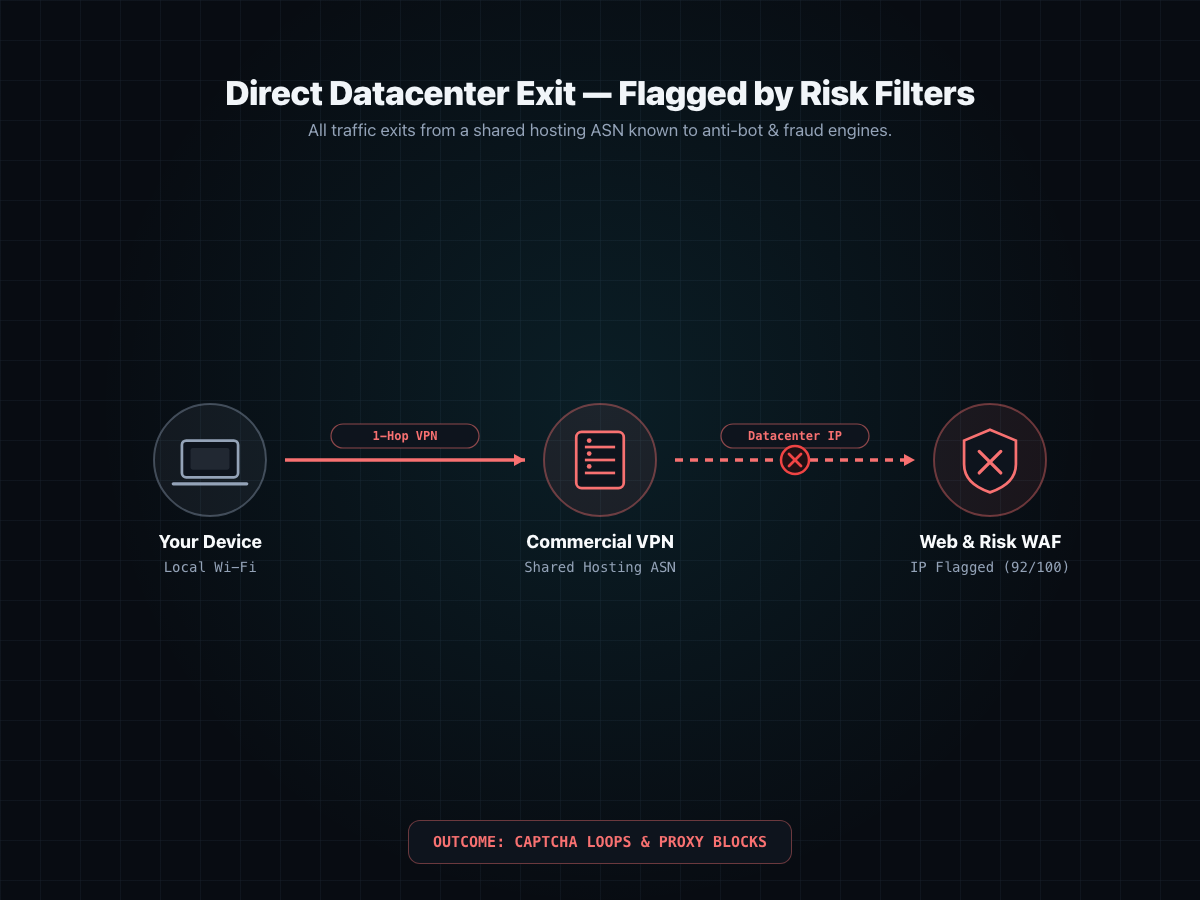
Why Commercial VPNs & Proxy Services Keep Getting You Blocked
Commercial VPNs cram thousands of users onto known datacenter IPs that banks, streaming apps, and anti-bot firewalls flag immediately, while residential proxy services charge $3–$8 per gigabyte.
Enterprise Networking, Configured Automatically in 3 Minutes
You don't need to know Linux routing or Xray configs. Our provisioner sets up all 9 security, stealth, and auto-tuning layers for you behind the scenes.
sni_mux) with automatic 8443 fallback if Port 443 is already in use.stream-up transport inside Xray-Core that resists packet-timing and flow-size ML classifiers.xPadding into HTTP frames to defeat packet-length statistical analysis.ICMP DF discovery auto-clamps the residential WireGuard interface to match your upstream path.
Conservative inner sizing prevents nested encapsulation drops across cellular and hotel Wi-Fi.
Automated --clamp-mss-to-pmtu iptables rules keep TLS handshakes fast and reliable.
Randomized frame padding masks payload lengths on hostile or throttled networks.
Works With Your Favorite VPS, Upstream WireGuard & Client Apps
No proprietary hardware or locked-in cloud. Connect any standard KVM VPS to any upstream WireGuard provider (such as a dedicated residential IP, your own home router, or a commercial VPN) and connect from any device.
Cloud VPS
$3–$5/mo HostsHetzner Cloud, Netcup, Vultr, DigitalOcean, Linode & any KVM VPS.
Upstream WireGuard
Any .conf ProfileDedicated residential IPs (TorGuard, StarVPN), your own Home WireGuard Server, or any commercial WireGuard provider.
Server OS
Debian RecommendedDebian 13+ recommended for fastest security patches, plus Ubuntu 24.04+ with automatic pre-flight verification.
Client Apps
5 PlatformsAmneziaWG (macOS, Windows, iOS, Android) & any VLESS client.
Provisioning
Desktop App
Native macOS (.dmg) & Windows (.exe) Desktop Provisioner with guided 3-step setup.
Buy 1 Residential IP Profile, Share It Across Every Device
Standard WireGuard configs lock one keypair to one device at a time. Your Virtual Router terminates a single
upstream residential .conf on your $4/mo VPS and multiplexes it cleanly across all your laptops,
phones, and tablets.
All Your Devices Connect Simultaneously
Each device gets its own VLESS REALITY link or AmneziaWG peer without kicking other devices offline.
VirtualPrivate.Network Relay
Terminates stealth L3/L7 tunnels and routes all client sessions out a single wg-upstream interface via isolated policy routing.
1 Dedicated Residential IP
Only one upstream WireGuard profile is required, saving $300–$1,500+/mo compared to metered per-GB residential proxy plans.
Home Router / GL.iNet
Run WireGuard on your own home router, Raspberry Pi, or NAS and export one client .conf.
- ✓ 100% genuine home broadband IP & ISP reputation
- ✓ Zero recurring upstream cost, unmetered home bandwidth
- ✓ Stealth VPS front-end bypasses hotel/corporate UDP blocks
TorGuard Residential IP
TorGuard's regular or dedicated Residential IP add-on (+ base plan) with native WireGuard .conf export and unmetered bandwidth.
- ✓ Static ISP residential IP without needing home hardware
- ✓ Multiplex 1 add-on across all your devices instead of buying one per seat
- ✓ Swap configs anytime via idempotent 1-click redeploy
StarVPN Static Residential
Exclusive static residential ISP slots (AT&T, Verizon, Comcast) with unmetered data and IP refresh credits.
- ✓ 1 WireGuard keypair multiplexed to your whole device fleet
- ✓ Unmetered bandwidth vs. $3–$8/GB proxy SaaS plans
- ✓ Includes up to 20 IP refresh credits/month
* Typical third-party upstream pricing shown for comparison (varies by billing cycle & promotions). Pair any WireGuard-compatible upstream with a ~$4/mo Debian/Ubuntu VPS.
From Blank VPS to Cloud VPN Router in 3 Steps
No manual iptables, no hand-editing Xray JSON, and no MTU guesswork. Connect your server in the Desktop Provisioner for macOS or Windows and let it deploy everything automatically.
Connect Your Blank VPS
Enter your VPS IP and login credentials in the Desktop Provisioner. Works with standard password or SSH key authentication.
Drop Upstream Config & Mode
Paste or load any upstream WireGuard .conf (residential, home, or commercial), then choose Dual-Stack
(AmneziaWG + VLESS REALITY) or Ultra-Stealth VLESS-Only with custom SNI mimicry.
Auto-Tune, Deploy & Scan QR
The engine runs live PMTU discovery, deploys hardened Docker containers, configures kernel policy routing, and displays ready-to-scan QR codes. Once provisioned, close the Desktop Provisioner. Your VPS runs 24/7 and your devices connect daily via AmneziaWG or any VLESS client.
1-Click Selective Update Manager & Safe Upgrades
Never worry about breaking upstream releases months later. Inspect 3X-UI, WG-Easy, and host WireGuard versions side-by-side, snapshot your SQLite databases automatically, and selectively upgrade components without wiping client profiles.
Dual-Stack or Ultra-Stealth VLESS-Only Templates
Deploy both L3 AmneziaWG and L7 VLESS REALITY together, or run VLESS-Only on TCP 443 for strict corporate, hotel, and national firewall environments.
Zero-Relay, No-Log Containers
Your encrypted packets never touch VirtualPrivate.Network servers, and both 3X-UI and WG-Easy run with Docker driver: none and Xray loglevel: none, writing zero connection or DNS logs on your VPS.
Included 3X-UI & WG-Easy Web Admin Dashboards
Manage family or team devices anytime via pre-deployed web panels: generate or revoke client QR codes and monitor per-client traffic, firewalled to tunnel/localhost access only.
Stop Renting Overpriced Residential Proxy Bandwidth
Pay once for the provisioning engine. Connect your own $4/mo VPS and residential WireGuard endpoint so you never pay per-GB markups again.
A typical remote worker uses 150–300+ GB/month across video calls, cloud apps, and streaming. At $3–$8/GB, metered residential proxies get expensive fast.
- ✕ $3–$8 per GB bandwidth markups for residential exit traffic
- ✕ Shared IPs abused by scrapers and bots on banking & streaming sites
-
✕
No VLESS REALITY +
xhttpanti-DPI obfuscation layer - ✕ Third-party provider sees your metadata and destination traffic
Full Desktop Provisioner for macOS (.dmg) & Windows (.exe).
- macOS (.dmg) & Windows (.exe) Desktop Provisioner
- Full AmneziaWG + VLESS REALITY (xhttp) Dual-Stack
- Automated Dynamic PMTU Prober & Kernel TCPMSS Clamping
- Built-in Selective Update Manager with automatic DB backups
- Zero per-GB bandwidth limits & 100% self-hosted privacy
Developed and supported by Blue Quills, LLC (Colorado, USA); billing handled by Polar. Instant app download via Polar with your license key emailed separately, 1 year of deployments, redeployments, and Update Manager updates (your deployed VPN keeps running indefinitely), and a 14-day provisioning refund guarantee if the software fails to deploy on a clean, supported Debian 13+ or Ubuntu 24.04+ VPS (excludes third-party VPS/ISP blocks).
 Instant License Key & App Download
Local Machine Execution
Runs locally on your Mac or Windows PC and connects directly to your VPS over SSH without relaying credentials through our servers.
Volatile Memory Only
SSH passwords and private key passphrases are held strictly in memory for the active session and are never written to disk.
Zero Telemetry
No analytics, tracking beacons, or usage profiling. Only your license key and node IP are verified during provisioning.
- Upstream WireGuard Endpoint Required (Sold Separately): To use VirtualPrivate.Network, you must provide your own upstream WireGuard endpoint, such as a home WireGuard router (e.g., a GL.iNet router) or a third-party VPN subscription (a residential IP add-on is recommended). Upstream endpoints and VPN subscriptions are sold separately and are not included with your license.
- VPS Hosting Required (Sold Separately): Your Cloud VPN Router runs on a Linux VPS (Debian 13+ or Ubuntu 24.04+) that you rent from your preferred hosting provider. VPS hosting is sold separately and is not included.
- No Guarantee of Unblocking or Ban Prevention: While routing traffic through a private or residential exit IP may improve consistency compared to using no VPN or a shared commercial VPN, we make no claims or guarantees that this product will unblock specific services or prevent account bans or blocks.
- No Guarantee Against Evolving DPI or Censorship: Stealth protocols such as VLESS + REALITY and AmneziaWG are designed to reduce protocol fingerprinting, but ISPs and telecommunications authorities continually update their deep packet inspection (DPI) and filtering methods. We make no claims that these protocols will bypass censorship or DPI filtering at all times or in all regions.
- Lawful Use Only: This product is intended strictly for legal use. You are solely responsible for ensuring that your deployment and usage comply with all applicable local, national, and international laws.
Everything You Need to Know Before Deploying
How does "Bring Your Own VPS & Upstream WireGuard" work?
Instead of paying us a recurring monthly fee for shared servers or per-GB proxy bandwidth, you rent a low-cost blank Linux VPS (e.g. Hetzner or Netcup for $3–$5/month) and plug in any upstream WireGuard configuration, such as a dedicated residential IP from TorGuard or StarVPN, your own home WireGuard server, or another VPN provider.
Our Provisioner automates the entire two-hop routing, stealth proxy, and MTU tuning stack in under 3 minutes.
Why use a Cloud VPN Router instead of a direct WireGuard VPN?
Two big reasons: stealth and device multiplexing.
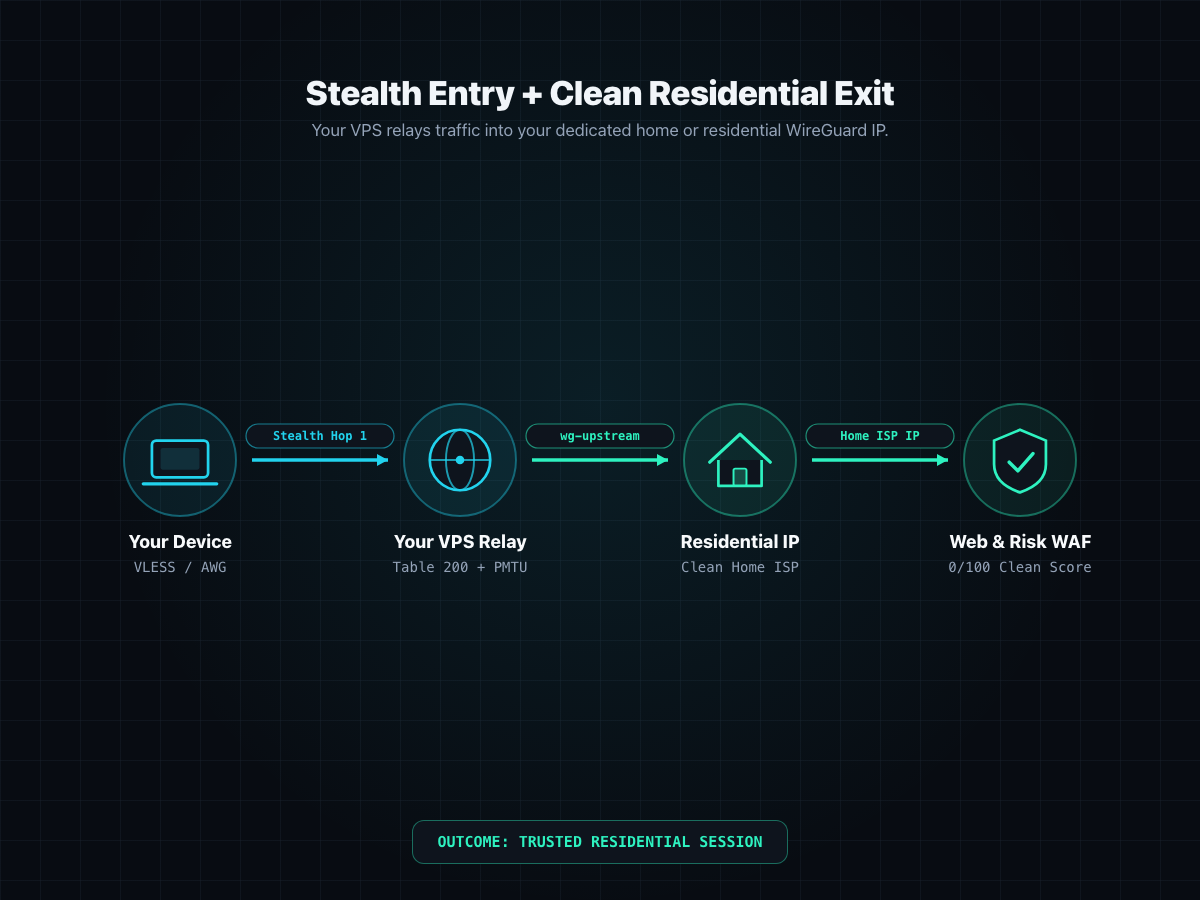
First, standard WireGuard UDP endpoints are easily fingerprinted, throttled, or blocked on strict corporate, hotel, and regional networks. By placing your own VPS in front as Hop 1, your devices connect using AmneziaWG or VLESS + REALITY over xhttp on port 443 (indistinguishable from Chrome HTTPS), then cascade cleanly out through Hop 2's upstream IP (for example, a clean residential IP).
Second, a raw upstream WireGuard .conf only supports a single active peer; connecting a
second device drops the first unless you pay for extra slots. Your Cloud VPN Router acts as a private
NAT gateway, letting you connect your phone, laptop, tablet, and family devices simultaneously through
one upstream profile with individual per-device QR codes.
Doesn't nesting two VPN tunnels cause slow speeds or packet fragmentation?
Naive nested VPNs break when inner packets exceed the outer tunnel's MTU.
Our installer solves this automatically with a live ICMP Don't-Fragment (DF) Path MTU probe
against your upstream endpoint, clamping the outer WireGuard interface, sizing the inner AmneziaWG
tunnel safely, and applying kernel TCPMSS clamping.
What VPS operating systems, SSH accounts, and client devices are supported?
VPS Operating Systems: We recommend Debian 13+ for the fastest security patching, and also support Ubuntu 24.04+ (with automatic Debian/Ubuntu pre-flight verification).
Desktop Provisioner: Runs on macOS and Windows, supports password or SSH key login (kept in memory only), and supports safe in-place redeploys that preserve existing client profiles when rotating upstream configs, DNS resolvers, or ports.
Client Devices: Connect from macOS, Windows, Linux, iOS, and Android using AmneziaWG or any VLESS client.
How is this different from 1-hop self-hosted VPNs like Outline or AmneziaVPN?
Tools like Outline and AmneziaVPN deploy a 1-hop VPN directly on your VPS, so all of your traffic still exits to the internet from a datacenter ASN IP that banking portals, streaming apps, and anti-bot WAFs frequently block.
VirtualPrivate.Network builds an automated 2-hop cascade: your devices enter through
stealth AmneziaWG or VLESS + REALITY on your VPS, and exit cleanly
through your upstream WireGuard IP (such as a residential IP, home gateway, or private exit node) using
isolated policy routing, strict tunnel-locked egress, and live
ICMP DF Path MTU probing.
Does any of my traffic pass through VirtualPrivate.Network servers?
Never. Our licensing API only validates your license key and node IP during provisioning. All VPN tunnels, private keys, and encrypted traffic stay strictly between your client devices, your VPS, and your upstream WireGuard gateway.